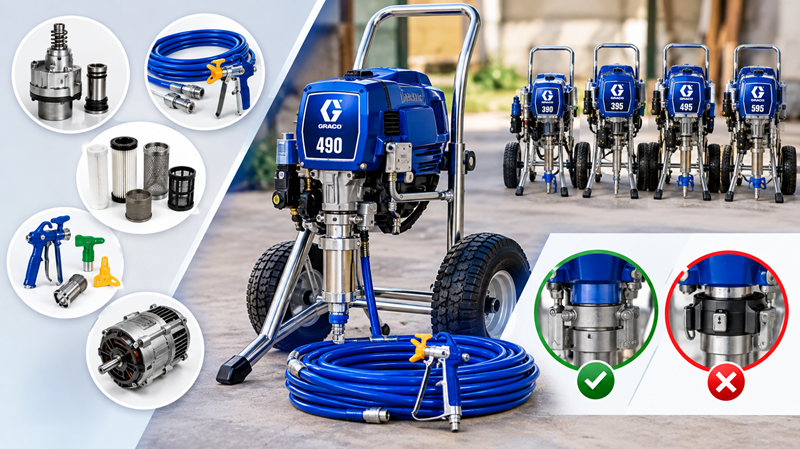
The 490 sits in an unusually crowded part of Graco’s electric lineup, and that turns out to be good news if you know how to use it. Several of the parts on a 490 are shared with the machines either side of it, which means a shop running a mixed fleet can cover three or four sprayers with one set of spares.
The catch is that the sharing is partial. Some things cross over completely, some things look identical and are not, and the pump depends entirely on which 490 you own. Here is how it actually breaks down.
First: Which 490 Do You Have
This has to come first because it determines the single most expensive part on the machine.
There are two distinct pump arrangements across the 490’s production history. The original Ultra Max II 490 uses a conventionally bolted displacement pump. The later PC Pro machines use Graco’s ProConnect system, where the pump lower releases without tools.
You can tell them apart in about ten seconds by looking at how the pump attaches. A quick release collar means ProConnect. Bolts and a wrench mean the earlier arrangement.
That distinction matters because the two pumps are not interchangeable. The mounting interface is different, so a ProConnect lower will not go onto a machine built for a bolted pump regardless of what else matches.
If the identification label is still readable, the model number settles it without any inspection. Write it down somewhere permanent while you can, because these labels do not survive years of solvent and sunlight. The Ultra Max II 490 PC electric airless sprayer parts listings are organized by assembly, which makes it easier to confirm which arrangement you are looking at.
What Crosses Over Completely
This is where the fleet economics get interesting.
The pump packing kits
The headline item. The packing repair kits that rebuild the 490’s fluid section also cover the 390, 395, 495 and 595. One kit on the shelf serves the whole family.
For a shop running, say, a 395 on interior work and a 490 or 495 on larger jobs, that is a single consumable covering everything. It is one of the better arguments for standardizing a fleet within one family rather than buying whatever was on sale.
There are two kit options in circulation: a standard packing set and a longer life version. Both rebuild the same pump. The choice is about expected service life, not about fit, which is a distinction a lot of listings fail to make clear.
Hose and whip assemblies
The fluid outlet thread is consistent across these machines, so hoses, whips and fittings move between them without adapters. If you have standardized on a hose length and diameter, it works on all of them.
Filters and screens
The fluid filter elements and inlet screens are largely common across the family. This is worth knowing because filters are the parts you should be changing most often, and buying them for one machine type rather than four simplifies the ordering considerably.
Guns and tips
Obviously, but worth stating: guns, tips and tip guards are not machine specific within this range. The constraint is tip size relative to the machine’s output, which is covered below.
What Looks Shared and Is Not
Now the parts that cause returns.
Motors
Motor part numbers vary by configuration and by production date, and a 490 does not share its motor with a 595. More subtly, two 490s of different vintage may not share a motor either. The parts manual lists several motor numbers against the same callout for exactly this reason.
There is a further wrinkle on the current machines. The latest 490 PC Pro uses a brushless motor, where the earlier machines were brushed. That matters practically: brush replacement is a routine, cheap repair on an older machine and is not a thing that exists on a brushless one. If you are searching for brushes for a recent machine, you are looking for a part it does not have.
Drive housings
More than one drive housing variant appears against the same reference number, differing by production. These are not cheap parts to get wrong.
Suction tubes and inlet kits
These differ between Stand and Hi-Boy configurations, which is intuitive once you think about it, since the geometry is different. The 490 PC Stand sprayer parts breakdown is configuration specific for this reason, and working from the wrong configuration’s listing produces a part that does not fit the frame.
Power cords
Three different cord part numbers appear across the range. A machine built for one will not accept another without work.
The pattern across all five of these: they are configuration dependent rather than model dependent. The model number alone is not enough. You need the model number plus the configuration, and ideally the series letter.
The Tip Size Ceiling Nobody Mentions
This is the most common misdiagnosis on a 490 and it is not a parts problem at all.
The 490 has a maximum tip size, and it is smaller than people assume. Fitting a tip above that limit does not produce more output. It produces a starved pattern with heavy tails, which looks exactly like a worn pump or a failing pressure control.
Plenty of 490 owners have replaced a pump to fix a pattern that was caused by over-tipping. The machine was working correctly the whole time; it was simply being asked for more volume than it makes.
The honest version of this advice is uncomfortable for anyone selling parts: if your work has moved toward heavier coatings or larger orifices, the answer is a bigger machine, not a bigger tip on the machine you have. A 490 with an oversized tip fitted is not a 495. It is a 490 producing a bad pattern.
Check the tip against the machine’s rating before you conclude anything about the pump. It costs nothing to rule out.
A Diagnostic Order That Saves Money
Work through these in sequence. Each step costs less than the next.
Will not hold pressure between uses. Drain valve first. These fail quietly and the symptom reads as a pump problem. Then the suction connection, then the inlet ball and seat, then the packings.
Pattern tails or will not fill out. Tip size against the machine’s limit, then tip wear, then gun filter, then fluid filter. Four cheap checks before anything expensive.
Pressure wanders or cuts out under load. Supply first, always. Generator rating, then extension cord gauge and length. Undersized cords and generators produce symptoms that look like control faults, and control boards have been replaced over this. Then the transducer, then the board.
Motor weak or intermittent. On an older brushed machine, inspect the brushes. On a current brushless machine, there are none, so check supply, cord, switch and control instead.
Weeping at the pump throat. Worn packings. This one is genuine and should not be deferred, because a pump running on failed packings damages the rod and cylinder.
The pattern worth noticing: on three of those five, the first thing to check is not part of the machine. It is the tip, the cord, or the generator. Supply problems and tip selection account for a remarkable share of parts orders that did not need to happen.
Building a Spares List for a Mixed Fleet
If you run more than one machine in this family, the stocking list is shorter than you would expect.
One of each, covering all machines:
- Pump packing kit
- Fluid filter elements
- Gun filters in your working mesh
- Inlet screens
- Drain valve assembly
- Tips in your common sizes
One per machine type:
- Suction tube or inlet kit matched to the configuration
Source when needed:
- Motors, drive housings, control boards, complete pumps
That first list covers most of what goes wrong, costs comparatively little, and serves the whole fleet because of the commonality discussed above. The second list is short but genuinely machine specific. The third list is where the money is, and those parts fail rarely enough that holding them makes poor sense for most operations.
Before You Place an Order
Three things, and they resolve nearly all of the confusion in this family:
Have the full model number, including configuration and series letter, from the identification label. If the label is gone, photograph the pump mounting and the frame.
Identify the pump by its own part number, not by the machine name. The 490 name covers two incompatible pump arrangements.
Rule out the cheap causes first. Tip size, tip wear, filters, drain valve, cord and generator. In that order.
The 490 is a well regarded machine and most of them are retired for reasons unrelated to the pump. The ones that cause their owners trouble are usually being run with the wrong tip, on inadequate supply, or with filters that have not been looked at in a while. None of those are parts problems, which is why the first thing worth doing is the inspection rather than the order.